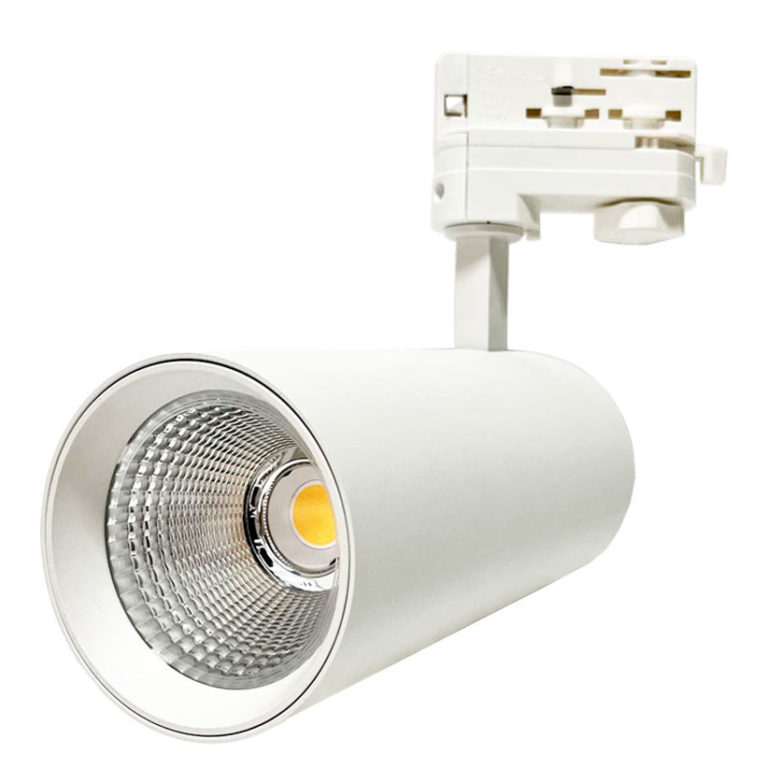
The ILED-TL-D DM is a COB track spotlight for rooms where the dimming runs on an ordinary wall dimmer rather than a control bus. There are three sizes in the range, all running at 100 lm/W. The ILED-TL-D2 DM is 10W, 1000 lumens. The ILED-TL-D3 DM is 20W, 2000 lumens. The ILED-TL-D4 DM is 30W, 3000 lumens. The three sizes share the same beam options, the same 2800K to 6000K color range and the same built-in driver, so a project can mix them on one track and run all of them from the same dimmer. Pick the wattage for the light level and the beam angle for the spread you want.
The Triac dimming side
The driver is built into the body, so there is no separate driver box to hide on the track or in the ceiling. The fixture takes a standard Triac dimmer: leading-edge or trailing-edge, the kind already on the wall in most homes and shops. Turn the dimmer and the whole group fades; there is no controller, no addressing and no software. That is the difference between this and a DALI track light, where the dimming runs on a bus and needs a controller. For a room that already has a plain dimmer on the circuit, this is the simpler option: wire the heads to the dimmer and they run on it. The driver is specified at order time; the body is just the optics and the heat sink, so the whole unit is one warranty item rather than a fixture plus a separate driver on a different warranty.
Beam and color
The lens is fixed, not zoomable: you choose 12°, 24°, 36° or 60° when you order. A 12° head is a tight accent spot for a single piece or a small display. A 24° head is the usual all-round accent. A 36° head opens the beam for a wider display or a wall wash. A 60° head is a soft flood for a group of objects or a whole counter. Because the beam is fixed per head, a project that wants different spreads on one track orders the different angles rather than re-aiming a zoom barrel. The color range is 2800K to 6000K, which covers a warm tungsten match through a neutral work light to a cool daylight tone. Standard color rendering is CRI 92, which is fine for most retail and general accent work. A CRI 97 version is available as an option, which matters when the light is on art, fabric or skin and the color has to hold up without a correction.
Body and mounting
The body is aluminum with a PC front, finished in white or black to match the rail. It clips to a 3-phase 4-wire European track or a 1-phase 3-wire US track, so the same fixture works in both wiring systems. Dimensions across the range are compact: D62mm and 170mm long for the 10W, up to D80mm and 185mm long for the 30W, with heights from 140mm to 175mm. Class I wiring, so it needs a proper earth connection. Input is 220-240VAC or the wide 110-277VAC version depending on the market, and the IP42 rating means it is for dry indoor ceilings, not a wet or outdoor position.
Choosing the size
The three wattages split by how much light the spot needs. The 10W D2 is for a single accent point, one piece of art, a small display or a reading position. The 20W D3 is the workhorse for a retail counter, a group of displays or a wider wash. The 30W D4 is for a large room, a high ceiling or a wider wash where you need the extra output without adding another head to the track. Because all three take the same track and run on the same dimmer, a room can mix sizes and the whole group still fades from one switch.
Where it gets used
Art galleries and museums, where a tight 12° or 24° CRI 97 spot sits next to a wider wash, and the whole wall runs from one dimmer instead of a control system. Retail and mall lighting, where a counter, a mannequin group or a feature wall each need a different beam and a different dimming level, all on the same track and the same dimmer. Hospitality, where a restaurant, a hotel lobby or a bar dims through the night on a wall switch rather than a hand on a keypad. Residential, where a piece of art, a shelving unit or a reading chair gets a focused spot that fades on the dimmer already on the wall, without any new control system to install. And in smaller commercial spaces, where a full lighting control system is overkill and a plain dimmer on the circuit is all the project needs.