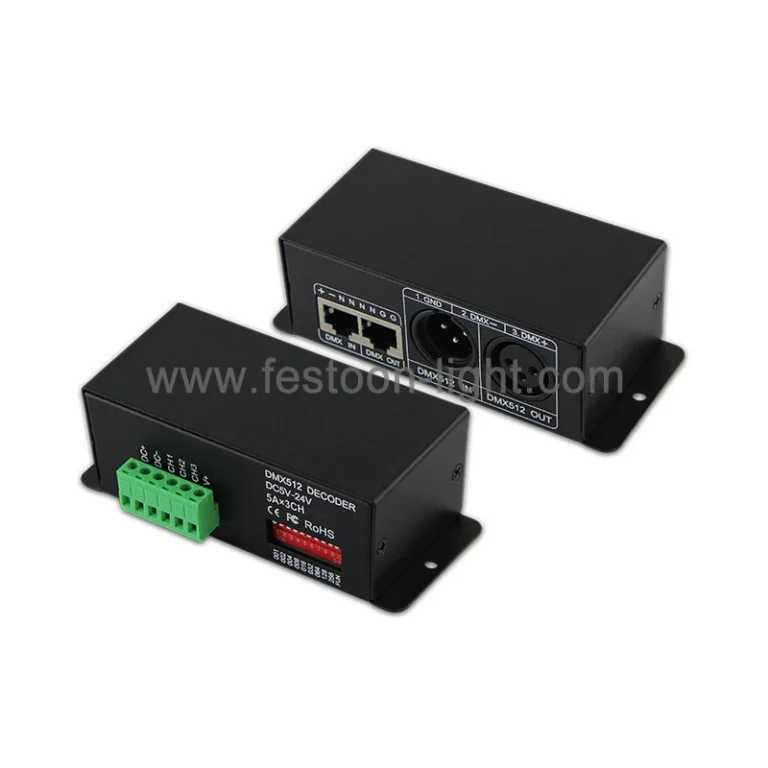
The FEL-CD264 is the 5-channel DMX decoder for the DIN rail: RGBWW output — red, green, blue, warm white and white on five separate channels at 5 amps each — with 4096 grey levels per channel and the DMX512/1990 line landing on the terminal block. It is the decoder for the large-scale panels that wire the DMX on the terminals rather than the RJ45, and the electrical set is identical to the RJ45 sibling in the range.
The five channels
The output is RGBWW — the RGB channels carry the colour mix, and the warm-white and white channels carry the tunable white independently, which is the set the dual-white strips and the colour-plus-white fittings run. The output is constant-voltage PWM at 5 amps per channel, so the strip and the fittings on the far side run at the voltage the supply delivers.
4096 grey levels per channel
Each channel decodes at 4096 levels, which is the resolution the smooth dimming needs: the fades run without the stepping the 8-bit decoders show at the low end, and the slow scene changes read clean on camera. The Highlights call it smooth, soft dimming, and the 4096-level decode is the number behind it.
Terminal block, master or slave
The DMX512/1990 line lands on the terminal block, and the controller runs as master or slave on the line: master for the standalone setups, slave for the desks and the main controllers. The terminal block is the simpler wiring for the panels without the structured cabling — the installer lands the wires directly, and the daisy-chain continues from the block.
Working envelope
The supply is DC12-24V, and the output power runs 300W at 12V or 600W at 24V — the higher voltage doubles the run the same copper carries. The working temperature is -20°C to +55°C, the dimension is 111×46×66mm and the weight is 135g, so the decoder is the panel-mounted unit the DIN rail carries without a shelf or a bracket.
Dónde se utiliza
The large-scale architectural installs, where the decoders line up in the distribution boards and the terminal blocks land the DMX per zone. Hotels and façades, where the RGBWW strips run the colour and the tunable white from one decoder per zone. Stage and studio rigs, where the CV strips need the DMX decode on the rail. And the retail and display installations, where the 4096-level decode is what the slow, camera-visible fades need.
Planning the panel
Three decisions shape the order: the decoder count against the strip load per zone, the supply against the 300W-at-12V or 600W-at-24V arithmetic, and the DMX addressing against the zones the desk or the master runs. Count the strip metres per zone, size the supply with the headroom, and number the decoders on the rail — the terminal block carries the line in the order the panel is wired. With those three set, the install is a panel-building exercise rather than a ceiling-void project, and the next contractor reads the layout off the rail.
Choosing the decoder in the range
The DMX decoder family splits by mount and connection: the CD264 is the terminal-block decoder on the DIN rail for the panels that wire the DMX directly; the CD268 is the same 5-channel RGBWW electrical set with the RJ45 socket for the structured-cabling installs; the CD269 series runs 24 and 32 channels for the multi-zone panels; and the CD206-4 is the standalone RGBW decoder with the XLR-3, RJ45 and terminal connections for the rigs. The choice is the mount and the connection the install runs — the 4096-level decode, the 5-amp channels and the master-or-slave logic are the same across the range.