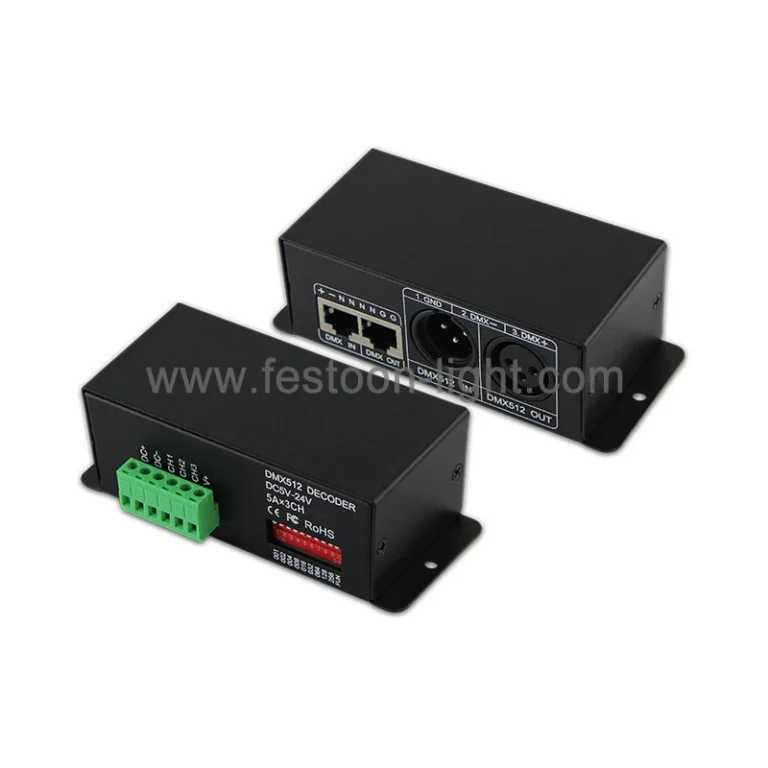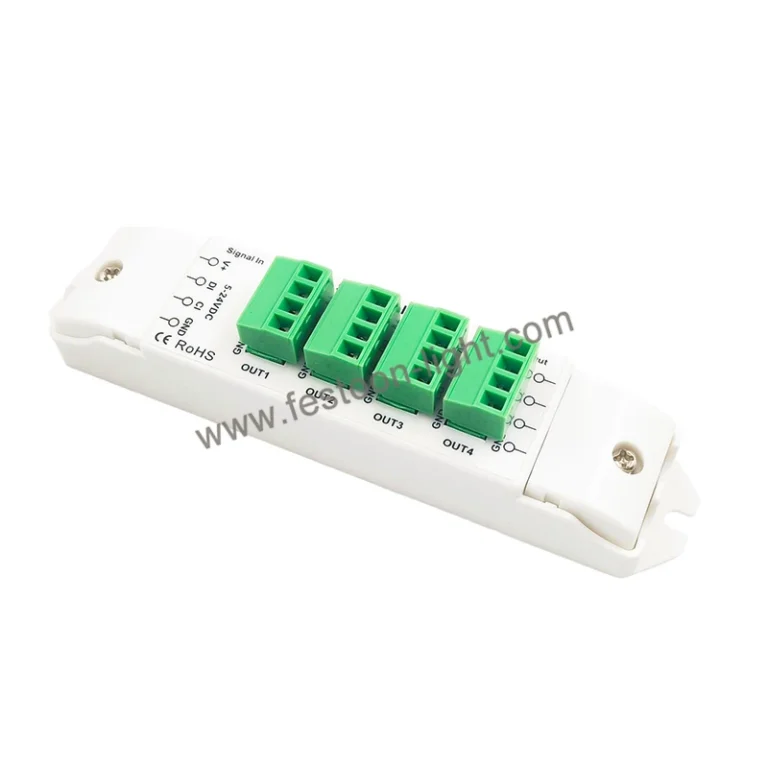



The FEL-CA1 is the compact Ethernet pixel controller — the four-port member of the CA family. ArtNet on the V1 firmware, ArtNet and sACN (E1.31) on V2, four pixel ports at 7 amps each with a 7.5A fuse on board, and the same fifteen-IC list the CA2 carries. The single DMX512 output port bridges 2×512 channels out to the decoders downstream, the web interface runs the config, and the firmware upgrades online. The body is 166×111.5×31mm at 510g — a mid-size plate between the slim decoder bodies and the CA2, for the pixel installs that need Ethernet control without the sixteen-port scale.
Four ports at 7 amps
The four output ports each carry 7 amps of pixel load, with the 7.5A fuse on board protecting the run. The pixel counts run per port: 340 RGB pixels on each of the four ports — 1,360 across the controller — or 256 RGBW pixels per port. That is the mid-density class: the façade sections, the bar and club builds and the retail installs that outgrow a single-port decoder and don’t yet need the CA2’s sixteen.
The pixel ICs it speaks
The output speaks the SPI protocols by IC name — 2811, 8904, 6812, 2904, 1814, 1914, 5603, 9812, APA102, 2812, 9813, 3001, 8806, 6803 and 2801 — the designations the strips and dots carry. The list matches the CA2’s, so the stock knowledge carries across the family. Match the IC on the strip to the port config and the pixels decode as addressed; ICs beyond the list get confirmed with the sales team.
ArtNet and sACN on the network
The Ethernet side speaks ArtNet on the V1 firmware, and ArtNet plus sACN (E1.31) on V2 — the two protocols the lighting networks run. One network line in carries the show data for all four ports, and the controller sits on the network like any other node: the console or media server addresses it, and the pixels on the far side follow.
The DMX bridge
The single DMX512 output port carries 2×512 channels out of the box — the bridge to the CV decoder family downstream. Pixels on the four ports, CV strips on the decoders, one show file driving both; the same pattern the CA2 runs, scaled to the smaller install.
Web interface, firmware and the plug-in design
The config runs through the web interface — the port setup, the IC selection and the network settings in the browser — and the firmware upgrades online. The DIP plug-in design keeps the wiring side serviceable: the connections come off in plugs, so a swap or a service happens at the connector rather than at the solder.
Working envelope
Working temperature spans -20°C to +55°C, which covers the plant rooms, the riser cabinets and the racks the controller lives in. The supply is DC5-24V with the 7.5A fuse on board, and the body is 166×111.5×31mm at 510g — a flat plate for the cabinet shelf or the rack, with the terminals and the Ethernet across its face.
Where it sits in the range
The Ethernet range scales by port count. The CA1 is this four-port unit at 7 amps — the mid-density class. The CA2 scales to sixteen ports at 5,440 RGB pixels for the media-façade builds, and the CA3 is the ArtNet-to-DMX gateway with no pixel ports at all. Below them, the CD1 adds the remote and the scheduled playback at the desktop scale, the CP2 decodes one port of 170 RGB pixels off the DMX line, and the CP1 runs the single strips on the inline RF remote. The CV decoder family hangs off the DMX outputs of them all.