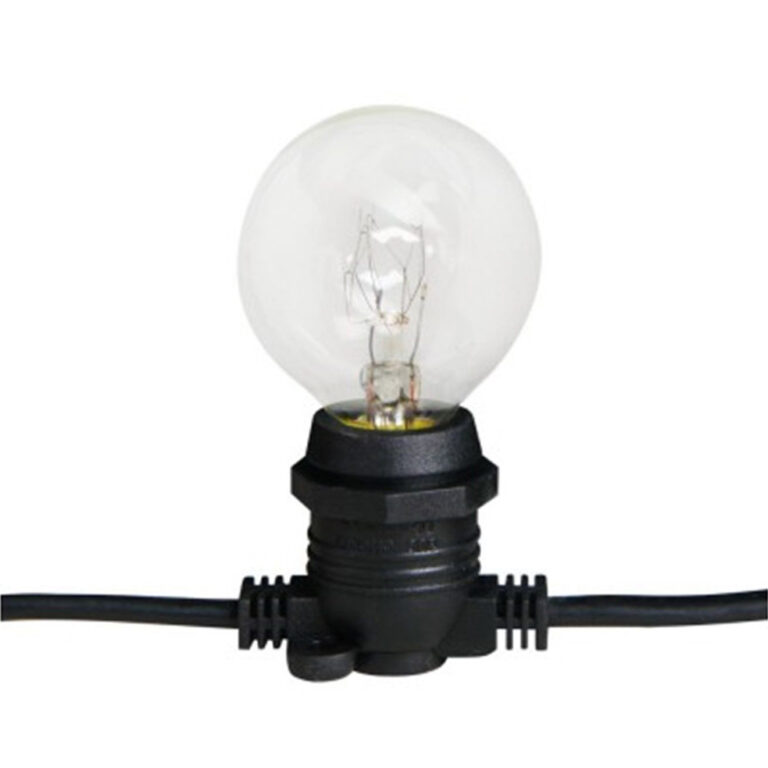



The ILED-BL031 L is the general-purpose bulb for the systems that run on batteries: a glass globe that takes the place of the mains bulb in the table lamps, the wall fittings and the pendants, running directly from a 10-36V DC supply. Where the candle version of the range serves the decorative fittings, the globe serves everything else — it is the everyday bulb of a solar home.
The wide low-voltage input
The input accepts 12V, 24V and 36V and anything between 10V and 36V, which is the range a real battery system delivers. A 12V bank sits at 13.8V while charging and sags under load; a 24V bank sits at 27.6V. A bulb built for exactly 12V fails across that range. This one takes the range as designed, so the bulb runs from a solar charge controller, a battery bank or a low-voltage garden supply without a transformer and without the voltage sensitivity that ends ordinary bulbs on battery systems.
The four outputs
The range runs 2W, 4W, 6W and 8W, ordered against the brightness the position needs and the budget the battery bank carries. The 2W and 4W suit the fittings that burn all evening; the 6W and 8W carry the reading positions and the rooms where the light is the working output. Colour comes in 3000K, 4000K and 6000K — warm, neutral and cool — chosen per room at order time.
The globe body and the caps
The body is glass, in the globe shape that suits the table lamps, the wall fittings, the pendants and the ceiling fittings a low-voltage system feeds. The cap choice covers E27 and E26 screw caps, E14 and E12 small sockets, and B22 and B15 bayonets, so the retrofit runs on the fittings the system already carries — no new fittings, no adapters.
Sizing the system around the bulbs
Because the bulb is a battery load, the order is part of the system design. Count the fittings, take the wattage of the bulbs you plan to run together, and check the total against the battery bank and the charge controller before ordering. The four outputs exist for that arithmetic: 2W in the fittings that burn all evening, 8W in the positions that run for an hour. That flexibility is what makes a solar room work — the light is budgeted like everything else on the system.
Où est-il utilisé ?
Solar homes and cabins, where the globe replaces the mains bulb in the everyday fittings. Boats and RVs, where the 10-36V input covers the supply charging and discharging. Garden and landscape circuits on a 12V or 24V supply. Off-grid and backup systems, where the lighting has to keep running when the mains does not. And anywhere a low-voltage circuit feeds a standard fitting that a mains bulb cannot serve.
Specifying the bulbs
Three decisions shape the order: the wattage against the brightness each position needs and the budget the bank carries, the cap against the fittings the system already runs, and the colour temperature against the room. Measure the supply at the position as well — the voltage a battery bank shows at the fitting is the figure the bulb has to live with, and the 10-36V range exists to cover it. With those three set, the retrofit is a bulb-swap across the fittings, and the system keeps the fittings it already has.
What it is not
The bulb is built for low-voltage DC in the 10-36V range. It does not run on 220-240VAC or 110-120VAC mains, and it does not belong on the mains side of the system. The specification does not list dimming either, so confirm with the sales team if the circuit runs a dimmer, and match the dimmer to the bulb and the supply before wiring. On systems without a dimmer, the bulb switches on and off from the circuit like any other fitting.