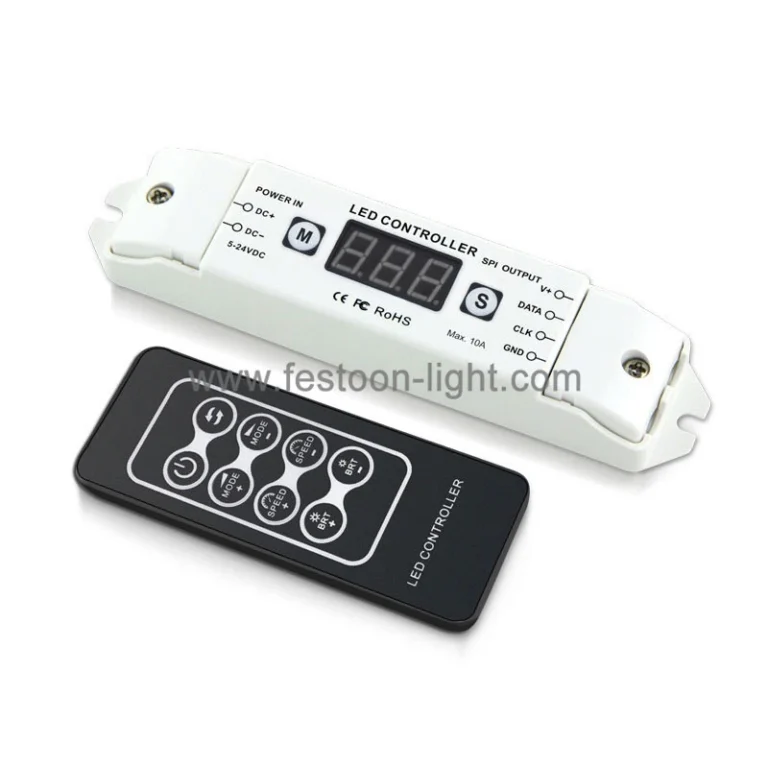
The FEL-CP21 is the inline amplifier for the pixel runs — the box that keeps the far end of a long install behaving like the near end. SPI signal in, amplified SPI out: the data re-drives at the amplifier, so the stretch beyond it runs as clean as the stretch before it. The output carries 8 channels on the single-wire ICs and 4 on the dual-wire ones, the load reaches 10 amps — 50 watts of 5V strip, 120 of 12V, 240 of 24V — and the DC5-24V supply matches whatever the run uses. The body is the familiar inline 135×30×30.2mm strip at 66g, hiding in the run beside the CP1 and the CP4. The specifications do not list a pixel-count figure — the amplifier’s job is the signal, and the pixel capacity follows the controller and the strip it serves.
The amplifier’s job
A pixel signal degrades over a long run: the data the controller sends at the start arrives tired at the far end, and the pixels at the tail flicker or misread. The amplifier breaks the run in two and re-drives the signal at the break — the drive and the range the Highlights promise. One amplifier resets the stretch; a large install chains them along the run at sensible intervals, and the whole length decodes as one continuous show. The alternative — hoping the far end holds — is the flicker the crews get called back for, and the amplifier is the fix planned in from the start.
Eight channels, or four
The output follows the IC’s wiring, per the specifications: 8-channel amplifier output on the single-wire ICs, and 4-channel on the dual-wire ones. The single-wire ICs carry their data on one conductor; the dual-wire ICs add the clock line. Set the run’s IC type and the amplifier’s channels follow — the amplification matches the strips it sits between.
10 amps and the power band
The load reaches 10 amps through the amplifier — 50 watts of 5V strip, 120 of 12V, 240 of 24V — and the supply ranges DC5-24V to match the run. That is the same power band the CP1 and the CP4 carry, so the amplifier holds its section of the install without the PSU coming up short. Size each amplifier’s section to the strip it drives, and leave the headroom at the top of the band rather than loading to the ceiling.
Working envelope
Working temperature spans -20°C to +55°C, which covers the coves, the cabinets and the risers the runs pass through. The body is 135×30×30.2mm at 66g — the same inline strip-style unit the CP1 and the CP4 use, a fraction taller, hiding in the run with the wiring it amplifies.
Où est-il utilisé ?
The amplifier earns its place wherever the run outgrows the controller’s drive: the long façade lines that stretch past the first few metres, the multi-storey coves, the perimeter runs around the club floor, the signage that snakes across the frontage. Insert it at the point where the pixels start to misbehave, and the far half comes back to life — or plan it in from the start on the installs that are large-scale by design, one amplifier per stretch, wired and hidden at the build stage rather than retrofitted after the first complaint.
Where it sits in the range
The CP21 is the companion to the pixel controllers rather than a controller itself: the CP1 and the CP4 run the single strips, the CP2 decodes the DMX into pixels, the CD1 and the CA2 sit at the desktop and the Ethernet scale — and the CP21 extends whatever they drive. Put it in the run wherever the signal needs the refresh, and the controllers keep doing their job at the head of the line.