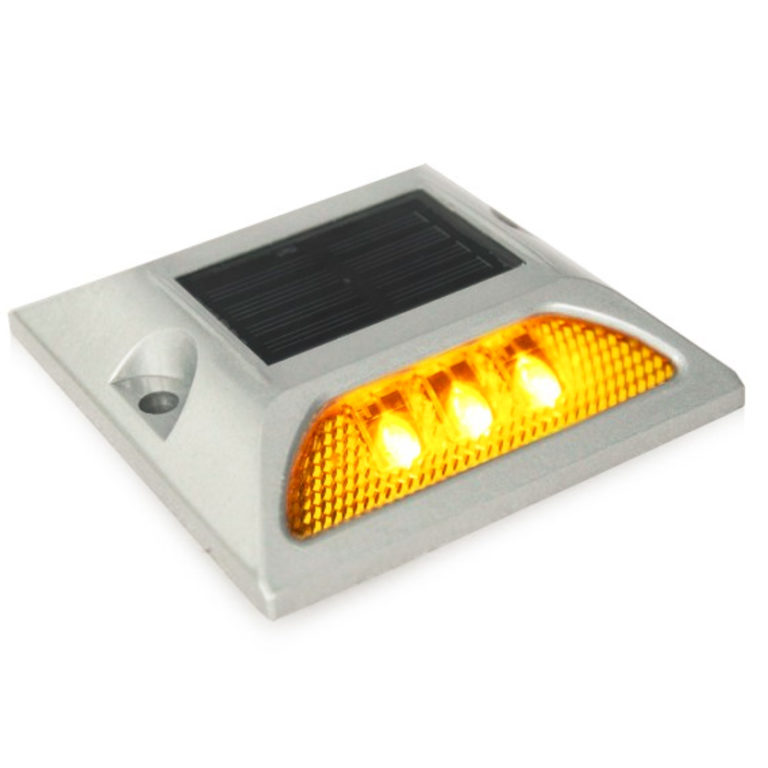
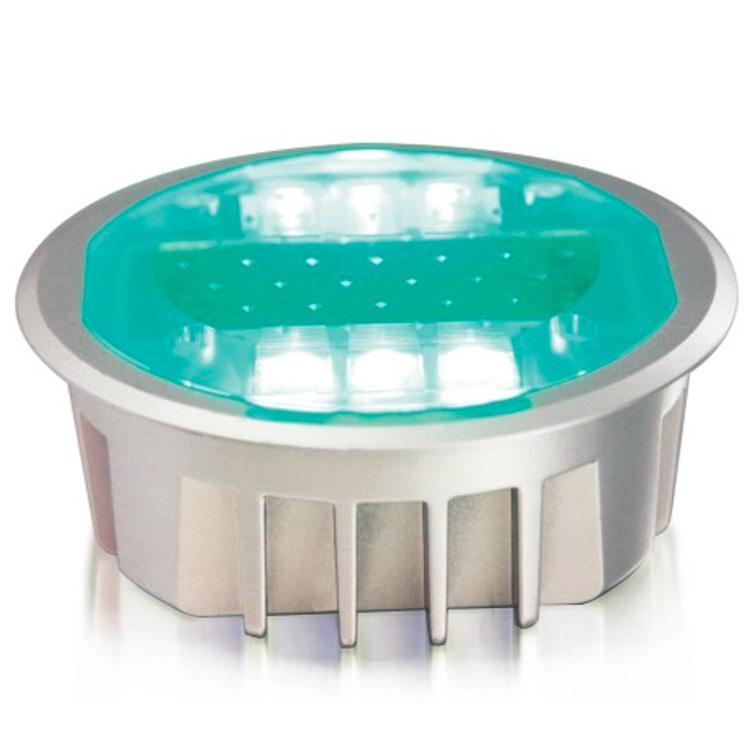
The ILED-RL-Q1 is the solar cat-eye stud that marks the road where the paint and the reflectors stop working: a polycarbonate dome set flush into the road surface, charging through the day and lighting the line through the night. It is the stud for the roads, the roundabouts and the crossings where the guidance has to survive the traffic, the weather and the dark.
Visible from 800 meters
Three Epistar 5mm LEDs per side sit behind the polycarbonate dome, and the visibility runs roughly 800 meters — the distance at which a driver on a dark road picks the line up before the headlamps sweep it. That is the number the road-safety positions are specified against, and it is the reason the stud replaces the passive reflectors that only work when the headlamps hit them.
Built for the road
The body is polycarbonate, rated to carry 20 tons — the load a heavy vehicle puts on the stud as it crosses. The working temperature runs -30°C to +75°C, so the stud survives the winter roads and the summer surfaces, and the sealed build keeps the weather out of the electronics. At D123×23mm and 0.39kg, the stud sets flush into the road and stays there.
The solar supply
The 2V 0.3W mono-crystalline panel charges the 1.2V 600mAh NI-MH battery through the day, and the stud runs 180 hours flashing or 40 hours steady on a full charge — the difference between the two modes is the battery budget the road manager chooses. The battery is rated two years with the stud, which is the service cycle to plan the replacements around.
Five colours
The LEDs come in red, white, yellow, blue and green, ordered against the road logic: white for the lane lines, red and green for the edges and the direction markers, yellow and blue for the special positions. The colour is chosen at order time per the road scheme. The battery is the service item — rated two years with the stud — so the replacement cycle is planned around the figure rather than waiting for the failures on the road.
Où est-il utilisé ?
Roads, highways and expressways, where the studs mark the lines through the unlit sections. Roundabouts and intersections, where the guidance has to read at speed. Bridges and tunnels, where the reflective markers fail without the headlamps. Pedestrian crossings and bike lanes, where the studs mark the crossing at the distance the drivers need. And the private roads and parking areas, where the solar supply skips the cabling the mains studs would need. The range also carries a 24VDC safety option, so the studs on the managed roads run from the circuit where it exists and on solar where it does not — the same fitting for both.
Installing the stud
The stud sets flush into the road surface at D123×23mm and 0.39kg, solar face up, in the drill-clean-fix procedure the road contractors run. Space the studs to the road scheme — the lane lines closer, the edges and the crossings at the spacing the guidance needs — and set them before the line painting so the crew marks around the positions. The 20-ton rating is what lets the stud sit in the traffic lane rather than at the edge, and the sealed polycarbonate body is what keeps it there through the seasons.
Solar or 24VDC
The Highlights list the supply options as solar or 24VDC, and that covers the two installs the roads run. The solar stud is the one for the unlit sections — the panel and the NI-MH battery make it self-contained. The 24VDC option is the one for the managed roads, where the studs join the circuit the control system runs and the photocell hands the switching to the network. Confirm which supply the road uses at order time, because the internal arrangement follows it.