

| Modèle | FEL-CD201 DMX Decoder 32 Channel RDM PWM RGB RGBW |
| Working Voltage | DC5-24V |
| Max Load Current | 3A/CH×32, Max 96A |
| Max Output Power | 480W(5V)/1152W(12V)/2304W(24V) |
| Scale Levels | 256 levels(8bit)/65536 levels(16bit) |
| Input Signal | DMX512/RDM |
| Output Signal | Constant Voltage PWM×32CH |
| Output Frequency | 1K、2K、4K、8K selectable |
| Decode Channel | 32CH |
| DMX512 Socket | XLR-3R/ Rj45/ Terminal block |
| Control Mode | DIM /CT /RGB /RGBW 4 modes switch |
| Working Temperature | -20 ~ 55°C |
| Controller Dimension | L195 X W145 X H38(mm) |
| Weight | 810g |
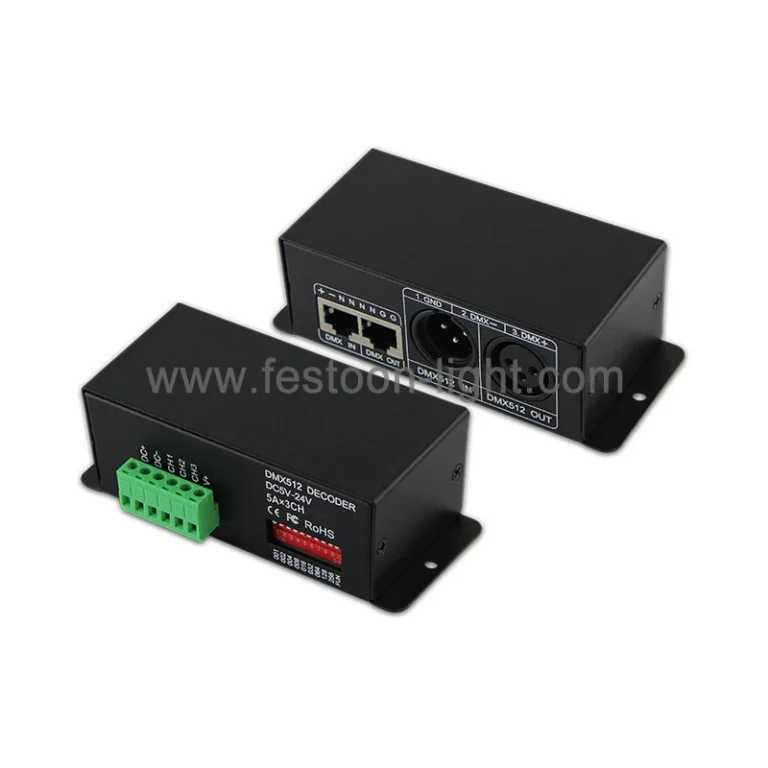
DMX Decoder 32 Channel RDM PWM RGB RGBW
The FEL-CD201 is the 32-channel flagship of the decoder family: constant-voltage PWM at 3 amps per channel — 96 amps and 2,304 watts at 24V — with RDM bidirectional control, the OLED display, an 8 or 16-bit grey scale and the four control modes: DIM, CT, RGB and RGBW. The DMX512/1990 line lands on XLR-3R, RJ45 or the terminal block, the PWM frequency selects across 1K to 8K, and the DC5-24V input takes the 5V strips. The L195×W145×H38mm body at 810g drives the large multi-zone installs.
Key Highlights
- 32 Channels, 3A per CH
- OLED Control
- 8/16-bit grey scales
- RDM Enabled
- XLR-3R,RJ45 and Terminal

Category: Décodeur DMX , Contrôleur d'éclairage
Tags: Éclairage événementiel
The FEL-CD201 is the 32-channel flagship of the DMX decoder family. Constant-voltage PWM at 3 amps per channel — 96 amps and 2,304 watts at 24V — with RDM bidirectional control riding the DMX line, the OLED display at the unit, an 8 or 16-bit grey scale and the four control modes: DIM, CT, RGB and RGBW. The DMX512/1990 line lands on XLR-3R, RJ45 or the terminal block, the PWM frequency selects across 1K to 8K, and the DC5-24V supply takes the 5V strips the 12-24V decoders leave out. The body is a large flat L195×W145×H38mm plate at 810g — the biggest channel count in the range, running the whole multi-zone install.
Thirty-two channels at 3 amps
The decoder carries 32 constant-voltage PWM channels at 3 amps each — 96 amps across the box, and the power figures follow the supply: 480 watts at 5V, 1,152 at 12V, 2,304 at 24V. The channels group by the wiring the run carries: eight RGBW fittings at four channels each, sixteen dual-white fittings at two each, or 32 single-channel circuits. That is a whole fitout off one decoder and one address run — the step up when the builds outgrow the four- and five-channel units.
The four control modes
The decoder switches between four control modes, set to match the wiring: DIM for the single-channel runs, CT for the colour-temperature circuits, RGB for the three-channel colour builds, and RGBW for the four-channel fittings with white. The mode is part of the config, so one part number serves the mixed installs.
RDM and the OLED
The DMX512 line carries RDM — the bidirectional side of the standard — so the fleet is discovered, addressed and re-configured from the console instead of unit by unit. A 32-channel block of addresses stays manageable from the desk as the install grows. For the site work, the OLED display at the unit does the same job locally: the mode, the address and the settings read and set on the decoder, no laptop in the ceiling void.
8 or 16-bit, and the frequency
The grey scale selects between 256 levels at 8-bit and 65,536 levels at 16-bit. At 16-bit the fades move in increments no eye reads as stepping — the low end of the dim holds its line across all 32 channels at once. The PWM output frequency selects across 1K to 8K, set per install in the config.
XLR-3R, RJ45 and the terminal block
The DMX512/1990 line lands three ways: the XLR-3R for the stage and event cabling, the RJ45 for the structured-cabling installs, and the terminal block for the panels where the line arrives on stripped conductors. The daisy-chain continues out of whichever connection the run arrived on. The 32 channels take 32 consecutive DMX addresses — the address run set at the unit or over RDM.
Working envelope
Working temperature spans -20°C to +55°C, which covers the plant rooms, the ceiling voids and the riser cabinets the installs run the decoder in. The body is L195×W145×H38mm at 810g — a large flat plate, wider than it is deep, with the terminals and the display across its face. It mounts where the multi-zone build needs it: in the riser, the cabinet or behind the control rack.
Planning the install
Work the load per decoder against the strips: 3 amps per channel, 96 amps across the box, and the power band that follows the voltage — 480 watts at 5V, 1,152 at 12V, 2,304 at 24V. Leave headroom below the per-channel rating rather than loading to it. Size the PSU for the connected load plus margin, land the DMX on whichever of the three connections the run uses, and set the mode, the bit depth and the frequency per install. The daisy-chain carries the line to the next decoder as the install grows.
Choosing the decoder in the range
The DMX decoder family splits by channel count, body and output type. The CD201 is this 32-channel RDM flagship — the biggest channel count and power figure in the range. The CD202 carries 24 channels on DC5-24V, and the CD269 series runs the 24- and 32-channel sets on the DIN rail. The slim bodies cover the smaller sets — the CD204 single channel at 10 amps, the CD205 two channels at 8, the CD206 three-channel RGB, the CD207 the RGBW with the 9-amp white channel, and the CD208 the four-channel RDM decoder with the 16-bit grey scale. The CD206-4 and CD209 are the standalone stage bodies with XLR-3, the CD203 is the large shutter-capable box, the CD23 is the constant-current set for the bare 1-watt LEDs, and the CD250 is the IP67 outdoor unit.
Why do buyers pick the FEL-CD201 over the alternatives? Here is what we hear from customers:
Thirty-two channels, 2,304 watts at 24V. The biggest channel count and power figure in the family — the whole multi-zone install off one decoder.
RDM and the OLED. The fleet is addressed and re-configured from the console, and the display at the unit does the same job locally.
65,536 levels at 16-bit. The highest resolution in the family — the low end of the dim holds its line across all 32 channels.
Four control modes. DIM, CT, RGB and RGBW switch in the config — one part number across the mixed installs.
All three DMX connections. XLR-3R for the stage, RJ45 for the structured cabling, terminal block for the panels.
DC5-24V with selectable frequency. The 5V strips come inside the range, and the PWM rate tunes per install across 1K to 8K, set from the console or the unit.
32 channels of constant-voltage PWM at 3 amps each — 96 amps maximum across the decoder, with 480 watts at 5V, 1,152 at 12V or 2,304 at 24V, and the grouping set by the mode.
Eight RGBW fittings at four channels each, sixteen dual-white fittings at two each, or 32 single-channel circuits — 32 consecutive DMX addresses per unit, grouped by the wiring the run carries.
DC5-24V — the 5V strips the 12-24V decoders leave out come inside the range. The power band follows the voltage, up to 2,304 watts at 24V, with headroom below the 3-amp per-channel rating.
256 levels at 8-bit or 65,536 levels at 16-bit, selected in the config. The 16-bit setting is the highest resolution in the family and keeps the low end of the dim free of stepping across all 32 channels.
The bidirectional side of DMX512 — the decoder is discovered, addressed and re-configured from the console over the same line, which is what a 32-channel block of addresses needs. The OLED display at the unit handles the same config locally.
All three — XLR-3R for the stage cabling, RJ45 for the structured-cabling installs, and the terminal block for the panels. The daisy-chain continues from whichever connection the run arrived on.
1K, 2K, 4K or 8K, selectable in the config alongside the bit depth — set per install rather than fixed at the factory.
The specifications list no warranty row, so confirm the warranty terms with the sales team at order time.
The FEL-CD201 drives the large multi-zone installs — the 32-channel flagship that runs a whole fitout from one decoder.
Large façades and media elevations. Per-floor and per-bay zones decoded in groups, 32 channels at 3 amps carrying the strips up the building, the daisy-chain linking the units.
Hotels and multi-zone hospitality. Lobbies, restaurants and corridors as RGBW zones off one box, the 16-bit fade keeping every zone’s dim smooth at once.
Retail floors and window schemes. Shelving, alcoves and backdrops decoded together, re-configured from the console over RDM as the floor plan changes through the year.
Stage and broadcast builds. The XLR-3R and RJ45 landings taking the desk line, the 16-bit grey scale and the selectable frequency covering the camera-visible fades on set.
Riser and control-rack installs. The flat 810g body in the rack, the terminal block taking the stripped conductors, the OLED reading the config on site.
For the smaller multi-channel sets, the CD202 carries 24 channels and the CD269 series runs 24 and 32 channels on the DIN rail; the slim bodies CD204 to CD208 cover the one-to-four-channel installs.
Customer Reviews
Bill Bryant
Interior Design
"iLed provides suitalbe DMX512 Decoder for their strip LED tape lights to us. They are working flow, stable, not flicker."
Mike Dean
Lighting Design
"Compare with other suppliers, we prefer to the controllers for RGB and RGBW LED Strip Lights from iLed. They don’t have flicker and stable."
Dean Sloan
Chef de produit
"iLed’s RGB or RGBW DMX decorders helped us much because of their easy using, strong functions and perfect compatibility."
Cornelia Sing
Sales Manager
"The guys of iLed are always patient and professional for us to solve all kinds of controller operation and using. We are now completely familiar with their dimmers, controllers, decoders. We can also quickly respond to customer projects and win projects."
David Hebert
CEO of EMS
"iLed is always able to quickly and professionally recommend the most suitable control system according to the requirements of our customers’ projects."
Ahamed
Purchasing Director
"iLed remommend their RGB controller for RGB COB LED strip lights, they both work well together.Their dual color,RGB or RGBW controllers can be a group by one remoter."
Bill Bryant
Interior Design
"iLed provides suitalbe DMX512 Decoder for their strip LED tape lights to us. They are working flow, stable, not flicker."
Mike Dean
Lighting Design
"Compare with other suppliers, we prefer to the controllers for RGB and RGBW LED Strip Lights from iLed. They don’t have flicker and stable."
Dean Sloan
Chef de produit
"iLed’s RGB or RGBW DMX decorders helped us much because of their easy using, strong functions and perfect compatibility."
Cornelia Sing
Sales Manager
"The guys of iLed are always patient and professional for us to solve all kinds of controller operation and using. We are now completely familiar with their dimmers, controllers, decoders. We can also quickly respond to customer projects and win projects."
David Hebert
CEO of EMS
"iLed is always able to quickly and professionally recommend the most suitable control system according to the requirements of our customers’ projects."
Ahamed
Purchasing Director
"iLed remommend their RGB controller for RGB COB LED strip lights, they both work well together.Their dual color,RGB or RGBW controllers can be a group by one remoter."
Bill Bryant
Interior Design
"iLed provides suitalbe DMX512 Decoder for their strip LED tape lights to us. They are working flow, stable, not flicker."
Mike Dean
Lighting Design
"Compare with other suppliers, we prefer to the controllers for RGB and RGBW LED Strip Lights from iLed. They don’t have flicker and stable."
Dean Sloan
Chef de produit
"iLed’s RGB or RGBW DMX decorders helped us much because of their easy using, strong functions and perfect compatibility."
Cornelia Sing
Sales Manager
"The guys of iLed are always patient and professional for us to solve all kinds of controller operation and using. We are now completely familiar with their dimmers, controllers, decoders. We can also quickly respond to customer projects and win projects."
David Hebert
CEO of EMS
"iLed is always able to quickly and professionally recommend the most suitable control system according to the requirements of our customers’ projects."
Ahamed
Purchasing Director
"iLed remommend their RGB controller for RGB COB LED strip lights, they both work well together.Their dual color,RGB or RGBW controllers can be a group by one remoter."
Related Products
Need Custom Solutions?
Toutes nos solutions d'éclairage LED peuvent être personnalisées en fonction de vos besoins. Nous proposons également des consultations gratuites et sans engagement, le développement de prototypes, des tests d'échantillons et pouvons vous accompagner dans vos projets de développement.
Simply contact us with your special requirements and our experts will gladly help you find the best solution for your project.