The ILED-TL-F is a zoomable LED track light in five sizes, from 10W to 35W, all built at 100 lm/W. A single head rotates its lens by hand to set the beam anywhere from a 15 degree tight spot to a 60 degree wide wash. The light source is a CREE COB, CRI 90 as standard and CRI 97 for color-critical work, with six color temperature presets from 2700K to 6000K. Dimming covers DALI2, Triac phase control, 0/1-10V and wireless Casambi, so the same fixture fits a shop with wall dimmers, a building with a central control system or a retail install where no extra wiring is wanted. The body is extruded aluminum in black, the driver is built in and flicker free, and the track adapters cover 3-wire single-phase, 4-wire 3-phase and 6-wire DALI2 3-phase rails.
Five sizes, one optic
The five models share the same head design and the same zoomable lens, differing only in size and light output. The ILED-TL-F1 at 10W puts out 1,000 lumens from a D50 x H132mm body. The F2 at 15W gives 1,500 lumens in D62 x H159mm. The F3 at 20W is 2,000 lumens in D72 x H171mm. The F4 at 30W delivers 3,000 lumens in D80 x H176mm, and the F5 at 35W reaches 3,500 lumens in D94 x H180mm. Larger bodies carry the higher wattages and keep heat out of the lens. Because every model zooms over the same 15 to 60 degree range, a project can mix sizes on one track and the beams all behave the same way: the size sets the light level, the lens sets the spread.
The zoomable lens
The lens barrel rotates by hand to move the beam from a 15 degree tight spot to a 60 degree wide wash. That is the working difference from a fixed-optic track light, where the optic is ordered per beam angle and is not user-swappable. Set the spread at the bench or on the ceiling, then re-aim it when the display, the artwork or the furniture moves. For a gallery, one head can run a tight spot on a single frame and open up to wash a whole wall of work. For a shop, the same head spotlights one counter and then widens to cover a display area. The tighter 15 degree end suits small high-value displays and accent pieces; the 60 degree end suits general display lighting and wide areas.
Light source and color
The source is a CREE COB, so the light comes out of one flat panel rather than a ring of smaller LEDs. Color rendering is CRI 90 as standard, with a CRI 97 version for the rooms where color has to hold up without correction: art, fabric and paint. Six color temperature presets run from 2700K to 6000K, which covers a warm boutique tone through neutral gallery light to a cool daylight feel. The CCT is ordered per fixture, so a project can mix temperatures on one track and keep each zone at its own level of warmth.
Dimming options
Four dimming routes are offered, and the fixture is built to the one the project runs: DALI2 for buildings with a central control system, where each head is addressed and grouped digitally and scenes can be programmed. Triac phase dimming works with standard wall dimmers, the simpler route for shops that want manual control without extra wiring. The 0/1-10V option takes an analog dimmer signal, the common route in commercial control panels. And Casambi runs the fixtures wirelessly: heads pair over radio, groups and scenes are set from a phone, and no control wire is pulled at all. All four ride on the same built-in flicker free driver, so the dimming curve is smooth at the low end and the light stays clean on camera.
Track adapters
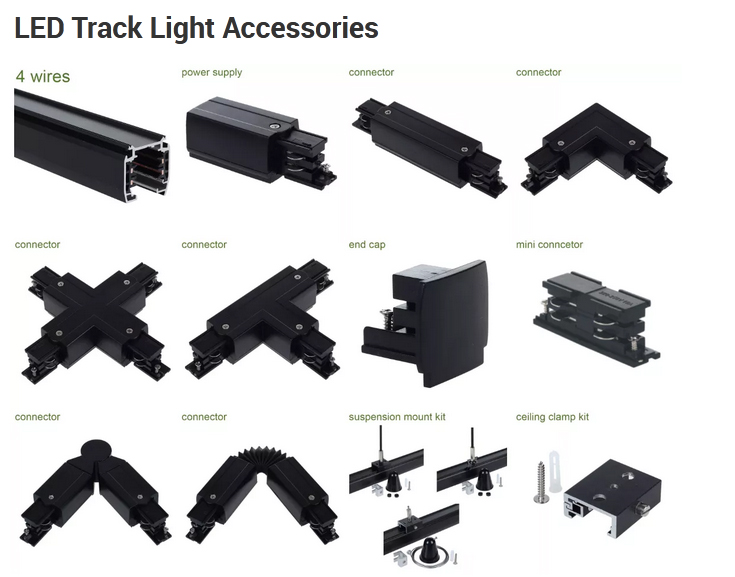
The track head ships with one of three adapters, matched to the rail the project already runs. The 3-wire single-phase adapter fits single-phase track, the standard rail in North America. The 4-wire 3-phase adapter fits European 3-phase track. The 6-wire adapter is the DALI2 3-phase version, for smart projects where the data runs on the track itself. Confirm the existing rail before ordering, because the adapter is fitted at the factory and is not a field swap. Heads from different sizes and different CCTs all take the same adapter family, so a track can carry the whole range.
Power and driver
Input is 220-240VAC for the European supply or 100-277VAC for the North American side. The driver is built into the body, so there is no separate box to find a place for on the track or in the ceiling. Power factor is above 0.9 and the output is flicker free, which matters where the light is on a sales floor with cameras running, on a stage with video capture, or next to a display screen. The fixture is electrical Class I and carries CE and RoHS.
Typical use cases
Art galleries and museums use the CRI 97 versions to keep color accurate on the work, with the zoomable lens moving between a tight spot on one piece and a wider wash over a wall of work. Retail and mall lighting runs the 20W to 35W sizes on counters, mannequin groups and feature walls, re-aimed as the merchandising turns. Hospitality spaces dim the heads to shift a reception or restaurant from service brightness to low evening light. Exhibition and trade shows are the natural fit for the zoomable optic: the layout changes between shows, and the same heads are re-aimed instead of a new set of fixed optics being bought for each event. In homes, a compact 10W or 15W head on a single-phase track lights a piece of art, a shelf or a reading chair without a row of downlights cutting into the ceiling, in line with how commercial lighting is planned for mixed-use spaces.